Showing posts with label Meet the Author. Show all posts
Showing posts with label Meet the Author. Show all posts
Tuesday, July 9, 2013


Wednesday, April 4, 2012
Christopher Moore is Coming to Edmonton April 25, 2012!!!
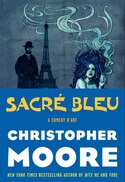
In Person: Christopher Moore
About this event:
Meet internationally bestselling author Christopher Moore as he signs his newest novel! Part mystery, part history (sort of), part love story, and wholly hilarious, Sacre Bleu takes on the Great French Masters in a quest to unravel the mystery behind the supposed "suicide" of Vincent van Gogh.
Event Guidelines:
• Line-up will be first-come, first-served.
• Must have a copy of Sacre Bleu to be in line. Proof of purchase required from any Indigo, Chapters, WBB or Coles location or indigo.ca.
• Candid photos – please have your camera ready.
• Personalizing Sacre Bleu. Signature only for any other titles.
Meet internationally bestselling author Christopher Moore as he signs his newest novel! Part mystery, part history (sort of), part love story, and wholly hilarious, Sacre Bleu takes on the Great French Masters in a quest to unravel the mystery behind the supposed "suicide" of Vincent van Gogh.
Event Guidelines:
• Line-up will be first-come, first-served.
• Must have a copy of Sacre Bleu to be in line. Proof of purchase required from any Indigo, Chapters, WBB or Coles location or indigo.ca.
• Candid photos – please have your camera ready.
• Personalizing Sacre Bleu. Signature only for any other titles.
Location: Indigo South Edmonton
When: Wednesday, April 25 @ 7pm
Follow @indigogreenroom on Twitter for up-to-the-minute event updates.
Friday, October 7, 2011
Meet the Author: Christopher Meeks, author of Love at Absolute Zero
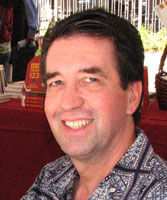
Meet Christopher Meeks. I had the opportunity to read his novel, Love at Absolute Zero and reviewed it yesterday on My Bookshelf.
Christopher Meeks kindly agreed to an interview to discuss his new novel, Love at Absolute Zero. Help me welcome him to My Bookshelf (applause and cheering....)
AN INTERVIEW BY SHIRLEY of My Bookshelf WITH CHRISTOPHER MEEKS
Thank you, Shirley, for letting me be a part of your website.
How would you describe your favourite genre to write in?
That’s my problem. I don’t have a genre, unless you call “literary” a genre—but that’s broad and probably the most difficult type of fiction to market. I had an agent who loved Love At Absolute Zero, and he brought it to editors at large publishing companies who had enthusiasm, but the marketing people in the companies seemed to feel it was like beef-flavored gum—interesting but they didn’t know how to sell it.
Someone on Goodreads called this book’s genre “Lab Lit.” That made me smile because first there was Chick Lit, then Lad Lit, now Lab Lit. It suggests there’s humor, romance, and science, which my book has. There’s probably not a lot of books within Lab Lit, but what the heck.
There’s also depth in the book that’s not necessary to see, but it’s there. As one customer review on Amazon said, “I don't give five stars just because I like a book, but usually have to be able to see more than entertainment to give that rating. Absolute Zero turned out to be great entertainment, but also much more.”
Writers who write in main genres such as romance, mystery, and thriller have an easier time getting published and having their books sell. That doesn’t mean this book won’t find a large audience. I’m impressed by the customer reviews coming in—people I don’t know—and I’m optimistic. Or maybe I’m just quixotic.
So is mystery your favourite genre to read?
I have to say I love how the Canadians and English spell “favourite.” I’m international now.
Yes, I enjoy the old mysteries such as Raymond Chandler and Dashiell Hammett, but Michael Connelly and Robert Crais are authors I often read. My former professor David Scott Milton’s new mystery, Iron City, which is only on Kindle now but soon will be in print, is dark like Chandler and Hammett, and I really love it.
However, it’s the contemporary literary books I love finding. I relish books that have great stories AND depth. When I find a book I love, I want to teach it. I happen to teach English at Santa Monica College, and I give myself the challenge of teaching two new books of fiction each semester, one by a male author, one by a female. Not only do I have to love each book, but I aim to have them grab my students who typically don’t read fiction.
What books, you might ask, fills all those requirements? This semester we’re reading The Art of Racing in the Rain by Garth Stein, and A Visit from the Goon Squad by Jennifer Egan. The first is told from the point of view of a dog whose owner races cars and the second just won the Pulitzer Prize and loosely revolves around a hit record producer and those associated with him before, during, and after his reign.
I’ve created a list on Amazon called Best Loved Novels I’ve Used Teaching English. You’ll see the books that have proven themselves such as Water For Elephants by Sara Gruen. These are books where a large part of the class reads ahead because the book is so good. That rarely happened in the English classes I took in college or high school. My goal is to show students that novels are where it’s at. If they come to love at least one of the novels in the semester, there are more books like them out there. Find them.
In short, I’m trying to deliver the spark that you clearly have and are flaming as you devote your days to reading and writing about new books.
Would you define your writing process for us? Do you use an outline?
I’ve changed over the years. One thing has remained constant: I write in the morning at the same desk. One of my mentors, the late and bestselling author Thomas Thompson (Blood and Money), told me his secret was writing at the same place at the same time each day. In that way, in a routine, you easily pick up where you last left off and you are productive. Even when my life is particularly hectic, I find time to write.
I used to be an anti-outliner—that outlines sucked out any creativity. My short stories were never written with an outline but with the curiosity to see where a story would go. When it came to novels, however, I quickly learned one can easily be lured away from the main story line, following a tangent that loses the reader. Then I discovered I don’t have to create outlines the way I’d been taught with levels using Roman numerals and capital letters and numbers. I discovered bullets.
What I now do is write outlines with mere bullet points to any given scene. In other words, novels are written in scenes, and each scene should deliver action and often realizations from a character. Scenes without either are not scenes but information dumps, which are boring. Exposition is needed but has to be metered out carefully. I want my reader involved in my stories, so structure is a big deal.
Outlines let me “What if?” What if such and such happens, where will the story go? What if something else happens?
This is to say outlining lets me imagine scenes faster than I can write them. I see them in my head, and if the scene isn’t interesting, I don’t write it. In the act of writing, I’m often surprised—I go off my outline. If I do, I return to my outline to see how the latest surprise changes things. I either adjust my outline or a scrap the surprise. With bullets, it’s easy to change an outline, and thus my outlines are organic and evolving.
You have published several other novels and short stories, what is your favourite so far? Why? What are some of your recently released titles?
I started writing plays and getting them produced, such as Who Lives? which is about the invention of the kidney dialysis machine and the first patients to try it out. In the sixties, when it looked as if the machine had been perfected, a committee was chosen to select people for it. Only a handful of people could be on it to see if there were any long-term consequences. Who would live?
In between writing plays, I wrote short stories. When I gathered enough courage and felt I had enough feedback that the stories were strong, I sent them out to literary journals—and was rejected like crazy. I realized, though, the journals were often staffed by eager college students who didn’t necessarily understand what I was doing, so I kept sending the stories around until they each found journals that would publish them. Once I had enough stories published, I put them in my first collection, The Middle-Aged Man and the Sea. That was well-reviewed and even mentioned by Entertainment Weekly as a collection to get. I put together a second collection, Months and Seasons.
Novel writing intimidated me, mainly because I didn’t think that writing short stories well necessarily led to great novels. I completely loved Lorrie Moore’s short stories such as in her collection, Birds of America, but her novels had never grabbed me. After reading Melissa Bank’s The Girls’ Guide to Hunting and Fishing, I saw I could create a series of short stories using the same characters and call it a novel. That’s how I built The Brightest Moon of the Century.
With my new novel, Love At Absolute Zero, I wanted a page turner. Rather than have chapters end with an ending (as short stories do), I wanted what a good mystery does, where you hit the end of the chapter and just have to turn the page. That meant a more traditional structure.
In short, everything I’ve written has been with a particular challenge in mind, and I’m proud of each of them. I’ll let critics choose which is best.
What are you working on now?
I’m polishing Falling Down Mt. Washington, a mystery novel about a young man, a theatre Ph.D. student who’s writing a dissertation on David Mamet and who’s at the end of his rope, desperately trying to get a job. While he’s applying at a Starbucks in a bank, the bank is robbed and he’s taken hostage. Now he really has to fight for his life.
I’m on the third draft and working with an editor.
About Love At Absolute Zero, can you relate to or do you know a Gunnar Gunderson?
I’ve always loved science—I was a kid when President Kennedy said we’d get a man on the moon by the end of the decade, and we did. I was a chemistry major for a year before I realized that’s not where my passions were. I like writing stories.
My wife happened to work in Caltech’s astrophysics library, so I met a lot of brilliant scientists there who could easily be Gunnar. One of them in particular helped in my initial research into studying the physics of the ultracold.
Do you believe in the scientific approach to love?
That’s one of the points of the novel—that it doesn’t quite work. Chaos is involved. Einstein never liked chaos in his science, even if (or perhaps because of) he had chaos in his love life. I’ve studied Einstein, too, and even wrote an entire screenplay called Einstein Loves. He had an amazing personal life, but people have made him such an icon, they don’t know him as a real person. He was living with his lover in Switzerland around 1905, and they had a child out of wedlock, who was lost to history or at least in most of his biographies.
Einstein was a Gunnar, now that I think of it.
In layman's terms, for the person who doesn't like or understand physics, can you describe "absolute zero"?
 Absolute zero—or very near it—is the coldest anything can get. It can get extremely cold in Canada and Minnesota (where I’m from) and thus -32 C (or -25 degrees Fahrenheit for us in the U.S.) is so cold that it’s just not pretty. Your nostrils sting breathing in that cold. Cars don’t start. However, that may as well be the sun for how cold cold can get. Absolute zero is 0° on the Kelvin scale, −273.15 ° on the Celsius scale, and −459.67 °F.
Cold and heat is just a reference to how fast atoms bounce around. The hotter something is, the faster the atoms move. Theoretically, absolute zero is where atoms stop moving. However, atoms never stop moving. We can only get within a few billionths of a degree from absolute zero, and at that temperature, atoms change and form a new state of matter called Bose-Einstein Condensates (BECs). The previously known laws of the universe change with BECs. For a cool YouTube video on BECs, click here.
How does "absolute zero" relate to the search for love?
That’s the fun of the novel, for the reader to see how love and quantum mechanics connect. Atoms in a Bose-Einstein Condensate lose their identity—so do people in love and those in misery from the loss of a love. Physics and love interconnect on so many levels. It might take the whole book to see, but it’s a fun journey.
You write of physics with a great depth, demonstrating a comprehensive understanding of the concepts of which you write. Did you take physics in school or is your knowledge a result of extensive research?
Both. I took a great class at the University of Denver, physics for non-majors. The professor gave all sorts of wonderful demonstrations. In my junior year abroad in Denmark, I lived with a family whose neighbor was a physicist, and he loved talking about how everything in our world comes down to 92 natural elements. The taste of your lover’s saliva, the fire where you cook marshmallows, the tent you sleep in—all are part of 92 natural elements. Scientists have a different way of seeing things.
I had to research a lot, however, to grasp a basic sense of quantum mechanics, and then I had to explain it to readers without boring anyone or drifting away from the story. It’s a tricky balance. Story comes first, then the science slips in where it doesn’t hurt anyone.
Who is your greatest influence in life? In your writing career?
We are all products of our environment, driven by whatever mysterious commands are in our DNA. In my Blake High school class of sixty-three young men, I was not the English geek or the jock or any of the many brilliant boys in the school. Al Franken, now Senator Al Franken, was a few years ahead of me. I have to say the school encouraged me in my senior year to try new things, to push myself, and I’ve done so ever since.
My mother was a voracious reader, and when I started writing, she became a fan long before I deserved to be. My father loved that I was writing stories, but he was also a tough critic. It was probably after my first book was well received that he saw that my stories could have open endings.
I’ve had some great mentors—author Thomas Thompson, playwrights David Scott Milton, Jerome Lawrence, and Robert E. Lee. Each held my plays or prose and went over them and gave me great advice.
I also learned a lot from reading my favorite authors, such as Tim O’Brien, Lorrie Moore, Margaret Atwood, John Irving, J.D. Salinger, Kurt Vonnegut, and many more. I also teach Children’s literature, and there’s a lot to learn from J.K. Rowling.
You’ve mentioned teaching English and writing on the college level. Has that helped you to analyze your writing process differently than you think others might write and edit their own work?
Teaching should also be on the list as a major influence in my life. Writing well cannot be done without reading a lot, and teaching novels has made me look closely at what certain writers do. I push myself to try new books every semester, even though it’s a lot more work, because I learn so much from each new novel. How the students react is important. What grabs their imaginations is so fun to see. When I witness that, I hope I find readers like them for my books.
In my Introduction to Literature classes, we study fiction, drama, and poetry—all of which can help any creative writer. Teaching is important because I’m witness to young people’s thirst for knowledge. I hope not to take away from that thirst but to let their genius come out. Teaching is a real balance in my life. It helps feed my writing.

Wednesday, June 29, 2011
Author Interview: Andrea Michaels "Reflections of a Successful Wallflower"
Andrea Michaels, of Extraordinary Events, is the author of Reflections of a Successful Wallflower - Lessons in Business; Lessons in Life. The following is an interview with this amazing woman:


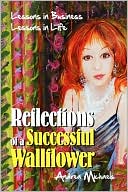 Reflections of a Successful Wallflower is available at Amazon, Barnes & Noble, and on the Outskirts Press site.
What is the title of your book?
Reflections of a Successful Wallflower - Lessons in Business; Lessons in Life.
What is your book about?
"This book is a life lesson, a success road map and a laugh-out-loud look into Andrea Michaels, one of the great business and creative minds working today." - John Klymshyn, Author of How to Sell Without Being a JERK! and The Ultimate Sales Managers' Guide.
Andrea Michaels is literally one of the backbones of the special events industry. She launched her event production business when there was no formalized or defined marketplace and became, and still is, a trailblazer, pioneering the way for others to follow. This book can only be compared to reading Andrea's diaries. This first inductee into the industry's Hall of Fame shares, candidly, not only the public wunderkind but the inner woman. Readers will discover the workings of one of the foremost event producers in the world. Her stories have made readers laugh, cry, and be in utter disbelief and fascinated at the same time. Her stories and her life are great lessons for everyone.

Why did you decide to write it?
I wrote the book for personal satisfaction AND because I hope that, in addition to being a fun read, it will inspire young people and women - two distinct populations I am dedicated to educating. Young people need to understand that their own power and internal drive can lead them to thinking creatively and decisively on more levels than tapping the keys on their computers for solutions. And women need to know that there is no "glass ceiling" if they can figure out a way to work around it. They have to believe that they can do anything, including raise a child, enjoy a marriage, run a business (do I sound like a Helen Reddy song?) [cue "I am Woman"] and do it all successfully and happily without sacrificing any one of these relationships.
My stories are about survival - business survival, and about approaches to challenges and how to overcome them. Business is no more than one element of life, and surviving in business is the same as surviving in life. It's all about approach and attitude.
How did you get your book published?
I decided I wanted to self-publish. I asked my editor to research what was available. After she presented me with all the options and recommended Outskirts Press, I went with them.
What type of readers will be interested in your book?
The obvious ones are other professionals in the special events industry and suppliers to that industry; business leaders, particularly women; young people interested in an incredibly creative and challenging career; women who have had challenging relationships in their lives. People who are looking for ways to laugh through the pain of working during difficult times and situations.
What is special about your book? What differentiates it from other books in the same category?
Most books by event producers display gorgeous photos of their events and talk a little bit about the. Others are "how to" books on the subject. My book is different because it reveals the challenges that I had to overcome to actually get the events produced. It intertwines my business and personal life. Each chapter is a story about an event and its challenges and the lessons I learned both professionally and personally, and I relate everything to my personal life. I expose my failures and my successes in an open manner.
Have you published any other books? Do you plan to publish more?
I have never published before, and I do plan to write a sequel to this one.
Reflections of a Successful Wallflower is available at Amazon, Barnes & Noble, and on the Outskirts Press site.Andrea's web page address: www.extraordinaryevents.net
Andrea's Outskirts page: www.outskirtspress.com/andreamichaels
Extraordinary Events office is located in Sherman Oaks, California.
To see my book review visit Reflections of a Successful Wallflower
Thursday, March 3, 2011
Meet the Author: Betty Byrd, author of Utopia Texas

About the author:
Betty Byrd started life as a competitive swimmer, field hockey player and cheerleader and then, after obtaining a degree in Creative Writing and doing graduate work, she became an editor for The Spectator, Ohio's largest weekly newspaper, and freelanced for a national men's magazine. Following that incarnation, she traveled to Southern California and worked as an actress in the television series Gunsmoke as well as in other films, mini-series and commercials. Her next "life" was that of a mother and, once her daughter was raised, she returned to her roots, writing. Her first novel, Trinity's Daughter, has now been followed by the award winning UTOPIA TEXAS. The author's website is http://www.bettybyrd.com/. Visit her page on Outskirts Press: www.outskirtspress.com/utopiatexas.
Tell me a bit more about the story behind this novel. From what I've read on your blog, your two novels, Trinity's Daughter and Utopia Texas are based upon your family. I'm sure this was difficult to write about. Did you find it liberating? At the age of 16 a Harvard psychiatrist advocated that I leave home. He said that the family chaos I was living in was an impossible situation. At that time I was attending a boarding school, so I listened to him and stayed away, visiting families all over the country. After seeing these families and how they related to each other I realized I was living a nightmare. Friends would say to me, "why don't you write your story it's so crazy? You need to write it down." In order for me to liberate myself from the pain I started my novel years ago, however after several years of therapy, I realized that I needed to step away from writing until I was able to let go of my anger.
After about 10 years I was able to look at my dynamic grandmother for what she was and (the hardest of all) was looking at my schizophrenic mother with sadness and pity. I realized that some people are not capable of helping themselves. They just don't know better.
I understand Utopia Texas is a sequel to another, Trinity's Daughter? Yes, Trinity's Daughter was published in 2004 and is the prequel to Utopia Texas.
Do you plan another book in this sequel? If so, when will it be available to the public? No, I do not plan to do another book in this sequel.
You're quite an accomplished woman. Does the draw of the theatre still entice you? I spent a good 25 years in the film industry as an actor. I don't think that you ever take that out of us. I cannot lie, being a voting member of Screen Actor's Guild, I'm always open to a film part. My major in college was Creative Writing and Theater, so I was always torn between the two. At this point in my life, I'm very fond of writing and enjoy being on the other side of the camera.
If you were to choose actresses to play Brya, Olivia and Maggie, who would you select and why? What about Cole and Brock? Would you use Utopia as the setting? It's been a dream of mine to see Utopia Texas in film. I believe that you would need an all star cast to play Brya, Olivia and Maggie because they are all so deep in their own way. That would be a challenge for any actress out there. If I were to cast Brya, I think that Glenn Close would be terrific. She has the strength and carriage. Olivia is more difficult because you need to have a beauty that spirals down into schizophrenia. Nicole Kidman would have what it takes. For Maggie. I like Chole Moretz who starred in the film, KickAss and has recently (been) making a Martin Scorcese film. She has depth and character and may be able to carry Maggie until she's 18, I don't know.
WOW! Cole and Brock...We're fast losing our cowboys, however, let's not underestimate Jeff Bridges as Brock. Tom Skerrit, or Sam Elliott would do Cole great justice.
*Utopia Texas would be the best setting for the film because that's where our ranch was located.
You quote Hemingway in your book and Mark Twain on your blog. Who are your favourite authors? How have they influenced your writing? Ernest Hemingway has been my mentor. He was one of the most charismatic personalities of his time, from his travels to his exploits, to his profound sense of human tragedy in his written works. He reinvented the novel with his journalistic style of writing driven by dialogue. I hope I'll have lots of lifetimes to try and write as well as this man, however, as one biographer concluded, "he wrote as naturally as a hawk flies and as clearly as a lake reflects."
What's next for you? More books, other ventures? I'm currently in the process of writing a global thriller.
Will your novels be available in retail stores other than Amazon? Utopia Texas is currently available in all retail stores. If it's not on the shelf you can order it.

Betty Byrd is an accomplished woman. Not because of her past, I think, but despite it. Ms. Byrd was awarded the Evvy Literary Award for her novel Utopia Texas.
Monday, February 28, 2011
Meet the Author: Kurtis Smith Author of Lessons From the Concrete Garden

With a diverse background as a United States Marine, sales and management professional as well as business owner and consultant, Kurtis Smith brings over two decades of experience and know-how to the table. He is the president and CEO of The K-Method Group, a teaching organization focused on teaching businesses, entrepreneurs and sales professionals the step-by-step processes of how to build, maintain and manage a book of business. His vision for the company is to continually provide the content and the environment where organizations and their salespeople can acquire the knowledge they need in order for them to flourish.
Lessons from the Concrete Garden

What is your book about?
The book is about providing real answers and solutions to selling professionals struggling to do their jobs daily. It was important to me to use real examples and relatable scenarios to make my points, not theories or conjecture so I drew from over two decades of experience in sales, management and business consulting to form my thesis. I decided to use the automotive dealerships as the case study to explain how an ambiguous policy regarding the development of selling professionals is not only a failing proposition, but a recipe for disaster. It allowed me to emphasize how a lack of a system to educate and measure a selling professional’s performance against a standard is responsible for the quality of the client experience and poor sales numbers which in turn leads to high employee turnover and business failure rates, regardless of industry. The goal of this book was to spotlight the profession as a whole in order to draw attention to the fact that there is no formal education program available to its practitioners and, in my opinion, is the reason for the extremely high failure rates.
This book introduces a solution in the form of Professional Standards for Sales Excellence, a set of systems and process that anyone can use to produce more predictable and consistent results as the new core competencies of professional selling and business development.
Why did you decide to write it?
I wrote the book out of a necessity to organize my thoughts in order to explain a process that is literally changing lives. There is a desperate need for a new approach to developing selling professionals and those responsible for business development and I had the answer. The problem was that the answer was more than one word and consisted of a series of systems and processes that when I tried to explain it to some, they would get this glazed over look on their faces because it was unlike anything they had heard before. The fact is that selling as a profession is not being taught at institutions of higher learning and is not looked upon as a real profession. However, when you consider that someone has to sell something in every company in order for them to stay in business; you would think that the person they hire would be of the highest caliber with the formal training to confirm what they know. Ironically it is just not the case.
I wrote this book to outline the standard and offer a solution by using the automobile industry as the case study, because what happened to them is a mirror image of what is happening in most businesses. But most importantly, it was written to give salespeople a roadmap to follow and management the understanding that without specific activities for them to measure against standards, it is difficult to do their jobs effectively.
What types of readers will be interested in your book?
The book was written to speak to three specific types of readers; the first being the selling professional who is struggling to produce consistent results and has no idea why he or she is struggling. The second is the entrepreneur or business owner who has a business and needs to put him or his sale force to work and does not know where to begin. And finally, for the sales managers who are responsible for producing results through a sales team and are still trying to manage by coercion, intimidation or even begging and pleading to produce results.
What is special about your book?
As James Dyson puts it, “Solve the obvious problems that others seem to ignore.”
Lessons from the Concrete Garden was specifically written to identify and address the reasons why salespeople struggle and fail. It provides answers that challenges the paradigm of those individuals stuck in this is the way we have always done it here mentality. It is an original thought written to provide hope for those looking for answers in a world full of sameness.
What differentiates it from other books in the same category?
I believe Lessons from the Concrete Garden focuses on substance by offering specific original solutions and not regurgitated rhetoric. My goal in this book was not to tell you what you should do, but to provide you with tangible solutions backed up with process based action plans.
Have you published any other books? Do you plan to publish more?
No I have not. Yes. There are several other projects in the works.
Blog Tour Links: http://www.kmethod.com/products.php,
Subscribe to:
Posts (Atom)
LinkWithin
